“Okiku and the World”: A Different Vision of Edo-Era Japan.
When it comes to jidaigeki (Japanese historical dramas), most people imagine honorable samurai and picturesque Edo-era villages. However, director Junji Sakamoto has a different vision in mind. His latest film, “Okiku and the World,” takes us to a grittier, darker side of Japan’s Edo era. The film recently screened at the International Film Festival Rotterdam.
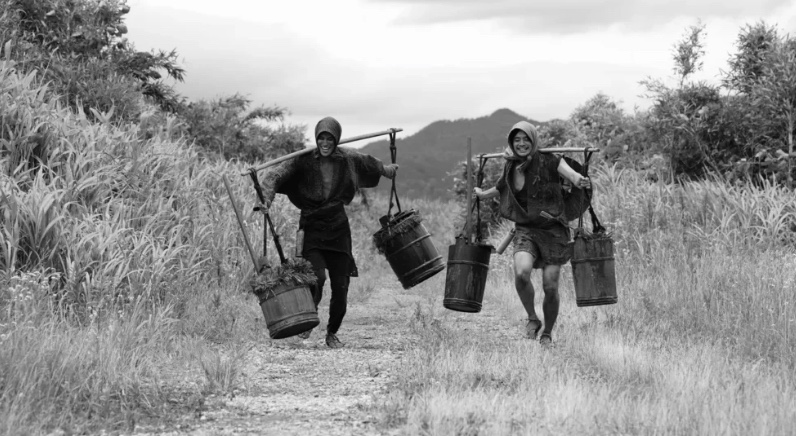
The story begins in the summer of 1858 and follows the lives of two vagrants, Yasuke (Sosuke Ikematsu) and Chuji (Kanichiro), who trade in a unique commodity – human excrement. As they collect and sell the feces to farmers as fertilizer, they find humor in their lowly existence, but it doesn’t exempt them from poverty. In one of the tenements where Chuji collects manure, a woman named Okiku (Haru Kuroki) suffers a tragedy that changes her life forever.
From the opening frames, it’s clear that Junji Sakamoto is not interested in romanticizing Japan’s Edo era. Unlike other filmmakers who aim to capture the beauty and charm of the period, Sakamoto presents a raw, unvarnished vision of Edo, complete with rivers of feces running through the streets. However, the stunning black-and-white cinematography helps to mitigate some of the film’s more revolting imagery. The film also features brief moments of color, which highlight both the beautiful and the grotesque.
Throughout the film, Sakamoto sheds light on the stark class divisions of the era. The relationship between Yasuke and Chuji and their experiences as excrement traders are a clear representation of the exploitation of the poor by the rich. This theme is also reflected in the central romance between Okiku, the daughter of an outcast samurai, and Chuji, a peasant excrement trader. Despite limited screen time, their relationship is intimate and touching, serving as a heartwarming contrast to the otherwise bleak lives of other characters.
Although the film features tragic characters, it also has a strong sense of humor. Sosuke Ikematsu’s Yasuke provides comic relief, while Renji Ishibashi’s portrayal of the elderly Magohichi is darkly comedic. The film is filled with toilet humor, but it’s also littered with black comedy, such as when Magohichi happily reports that he intends to build his own coffin.
In conclusion, “Okiku and the World” is a shit-filled yet soulful jidaigeki that presents an unorthodox depiction of Edo-era Japan. Beautifully shot and filled with tender moments, this unique period drama is worth watching despite its darker themes.
 Mixed Media Magazine